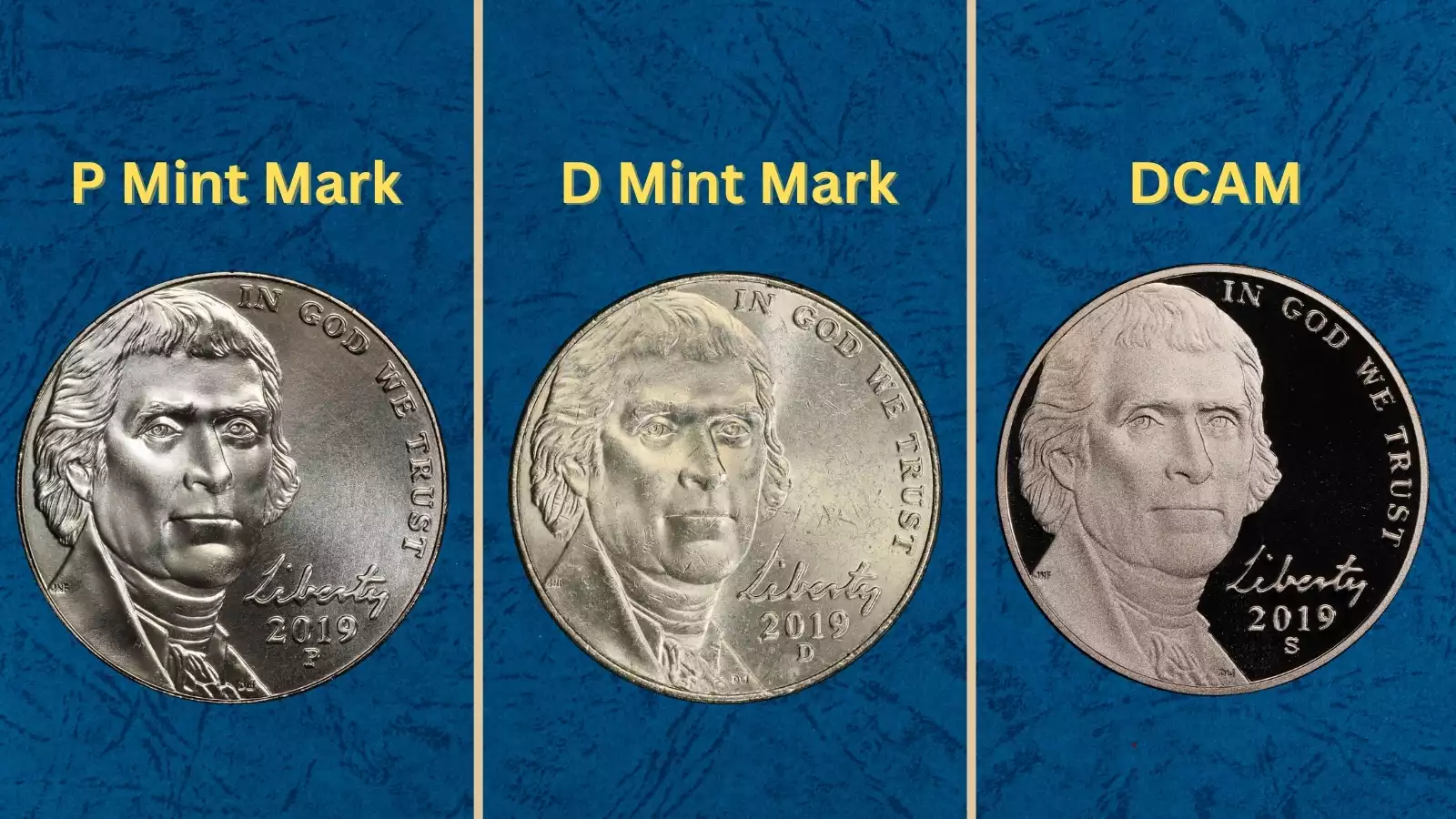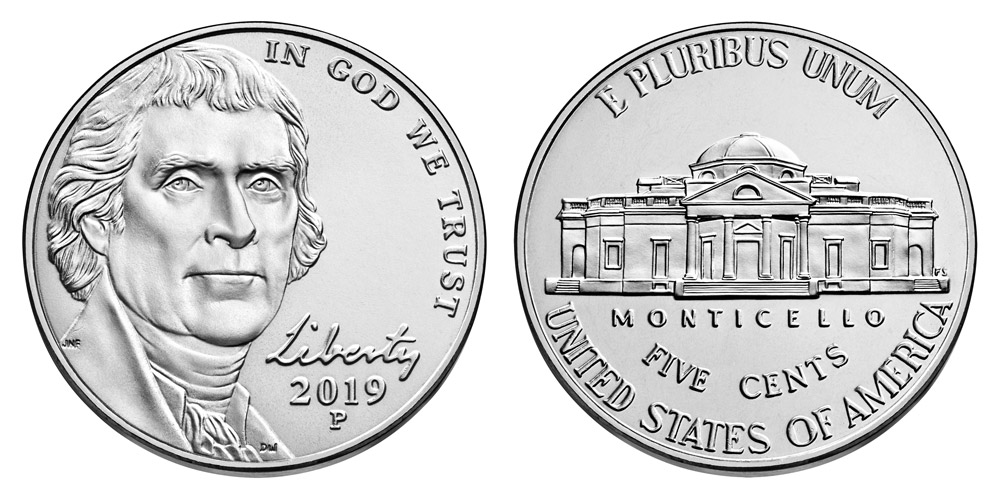
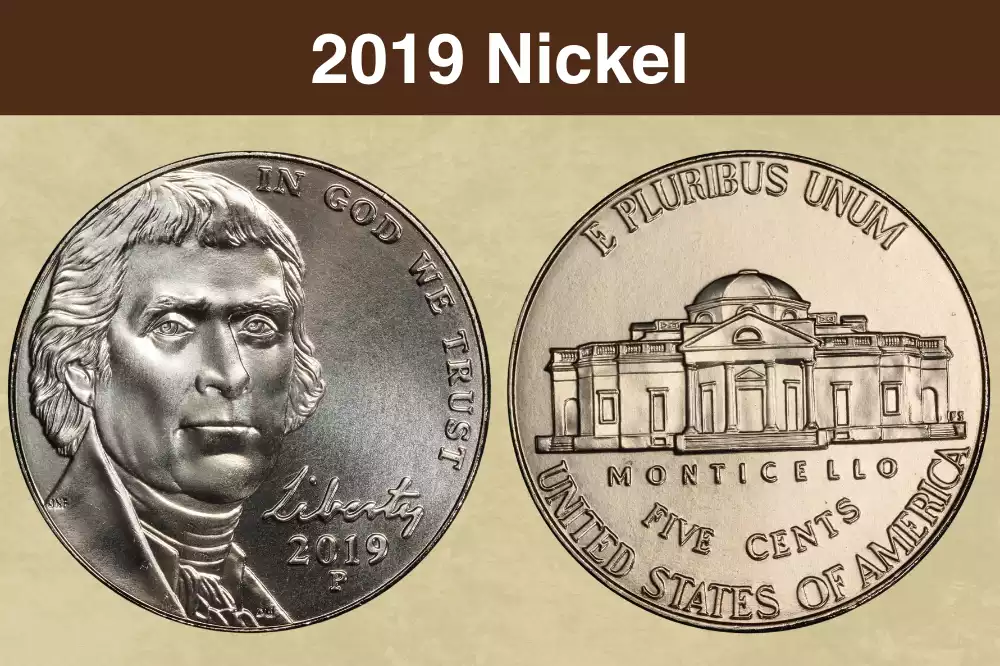
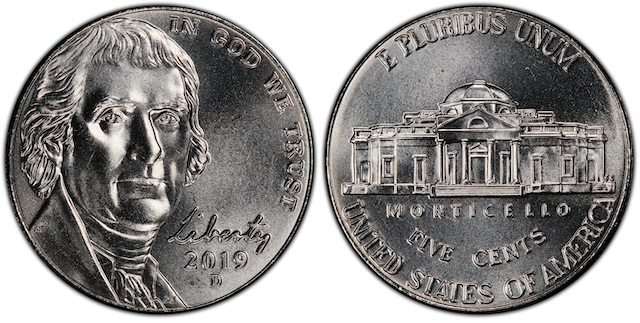
2019 Jefferson Nickel obverse showing Thomas Jefferson portrait and reverse showing Monticello

Your 2019 Nickel Value: From 5¢ to $250+

A 2019-D Jefferson Nickel in MS68 sold for $250 — yet most examples in your change are worth exactly a nickel. The difference comes down to one number and three steps at the bottom of Monticello. Use the free tools below to find out which side of that gap your coin sits on.

★★★★★ Trusted by 12,000+ collectors — free, instant, no signup required
Check My 2019 Nickel Value →
$250 Top sale (2019-D MS68, eBay 2019)
1.09B Total 2019 nickels struck (all mints)
3 PCGS pop for 2019-D MS68FS (ultra-rare)
20× Full Steps premium over non-FS at same grade

Free 2019 Nickel Value Calculator

Select your mint mark, condition, and any known errors below for an instant value estimate.

Step 1 — Mint Mark

Step 2 — Condition

Step 3 — Special Designations or Errors

This calculator works best if you already know your coin's mint mark and condition — if you're unsure about any of those details, a 2019 Nickel Coin Value Checker online tool lets you upload a photo and get an AI-assisted reading before you come back here.

Full Steps Self-Checker

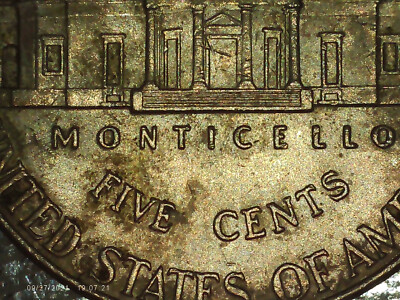
The Full Steps (FS) designation is the single biggest value driver for 2019 Jefferson Nickels. Use this tool to determine whether your coin qualifies.

Side-by-side comparison of 2019 nickel without Full Steps (left) and with Full Steps (right) showing Monticello staircase detail

❌ Regular Strike — No FS Premium

  • Steps at Monticello's base are blended or incomplete
  • One or more step lines broken or missing across the width
  • Die wear or weak strike visible under 10× magnification
  • Value stays at $1–$9 even in Gem Uncirculated condition
— vs —

✅ Full Steps — Major Premium Applies

  • Five or six complete, uninterrupted horizontal step lines visible
  • Each line runs full width of the staircase with no breaks
  • Crisp, sharp strike from a fresh, perfectly aligned die
  • MS67FS worth $40–$75; MS68FS worth $200–$350+

Got a Full Steps result? Now find out exactly what that means for your coin's value.

Run the Value Calculator →

Jump to Any Section

The Valuable 2019 Nickel Errors — Complete Guide

Most 2019 nickels are worth exactly five cents, but a small percentage carry minting mistakes that transform them into collectibles worth $30 to $600 or more. The five varieties below account for most of the premium examples documented in the current market. Examine each one carefully — several can be spotted with nothing more than a 10× loupe and good lighting.

Close-up of 2019 nickel Full Steps designation showing all six crisp horizontal staircase lines at Monticello base

Full Steps (FS) Designation

MOST FAMOUS
$20 – $350+

The Full Steps designation is not a minting error in the traditional sense — it is a strike-quality designation awarded by PCGS and NGC to 2019 Jefferson Nickels that show five or six fully formed, uninterrupted horizontal step lines at the base of Monticello on the reverse. Because the steps occupy the deepest cavity of the reverse die and sit directly opposite a deep obverse cavity, the metal must flow perfectly during the strike to fill them completely.

To qualify, the step lines must run the full width of the staircase base with no breaks, blending, or weak spots caused by die fatigue, alignment issues, or planchet contact. PCGS awards the "FS" designation when five steps are fully visible. NGC uses "5FS" for five steps and the even more selective "6FS" designation for six complete steps — a rare achievement on any modern Jefferson Nickel.

Collectors pay enormous premiums for FS-designated 2019 nickels because they represent the best strikes from the freshest dies. The value gap between a standard MS67 and an MS67FS can be 5× to 10× at the same numerical grade, and the PCGS population for 2019-D MS68FS stands at only 3 confirmed examples — making those coins genuine modern rarities despite the billion-coin mintage of the year.
How to spot it

Flip the coin reverse-side up under a 10× loupe. Focus on the staircase at Monticello's base. Count the horizontal lines: five or six fully continuous lines, each running the entire width of the stairway without any interruption, indicate Full Steps status.

Mint mark

P (Philadelphia) and D (Denver) business strikes only. The S (San Francisco) proof is exempt — proofs are expected to be fully struck by default.

Notable

The 2019-D MS68FS has a PCGS population of just 3 graded coins. A 2019-D MS67+FS sold for $237 on eBay in July 2019 (PCGS CoinFacts). A 2019-P MS68FS sold for $195 on March 30, 2022, on eBay per PCGS CoinFacts. Only the 2019-D is offered in the exclusive Explore & Discover Set with FS PL designation.

Close-up of 2019 nickel Doubled Die Reverse showing doubled architectural details on Monticello columns and lettering

Doubled Die Reverse (DDR)

MOST VALUABLE ERROR
$30 – $200+

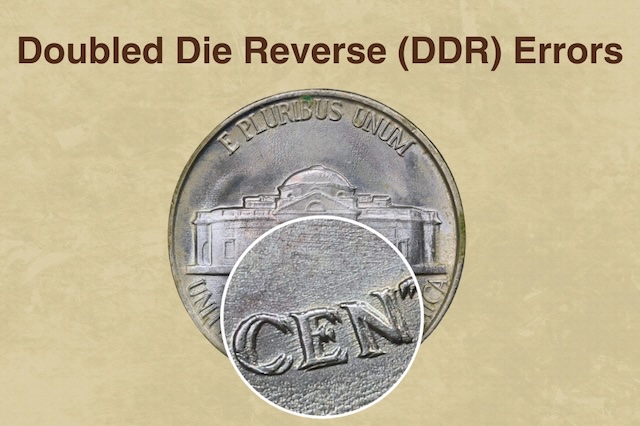
The Doubled Die Reverse (DDR) occurs during the die-making process, not during striking. When the working die is hubbed — pressed against a master hub to receive the coin design — a second hubbing impression lands at a slightly different angle or rotation than the first. The resulting die has doubled design elements baked permanently into the steel, and every coin struck from that die will show the same doubling.

On 2019 nickels, DDR varieties show most clearly on Monticello's architectural elements: the columns, the windows above the door, the curved triangular pediment, and the lettering of FIVE CENTS and UNITED STATES OF AMERICA on the reverse. Brian's Variety Coins catalogs more than 70 distinct Doubled Die Reverse varieties for the 2019-P issue alone (WDDR-001 through WDDR-074+), ranging from very minor to visually dramatic class separations.

The most collectible DDR varieties are those showing dramatic Class I (rotated hub) doubling visible to the naked eye or under minimal magnification. Coins with strong, easily confirmed doubling command premiums well above face value even in circulated grades. Gem uncirculated examples of the strongest DDR varieties can trade in the $50–$200 range when the doubling is sharp and attributed by a recognized variety guide.
How to spot it

Examine Monticello's columns and the reverse lettering with a 10× loupe. Look for a secondary shadow or notch at the edge of each architectural element. True DDR shows consistent doubling direction across multiple design elements — not random die damage or machine doubling.

Mint mark

Primarily P (Philadelphia) issues. Brian's Variety Coins lists 70+ WDDR varieties for 2019-P. Denver DDR varieties also exist but are less cataloged.

Notable

The Wexler Doubled Die Reference (WDDR) catalog lists 2019-P WDDR-065 as a "Best Of" variety — the strongest and most visually dramatic of the 2019-P doubled die reverses. Uncirculated examples with clear WDDR-065 attribution carry strong collector premiums. Attribution using a specialty reference like CONECA or Wexler is recommended before selling.

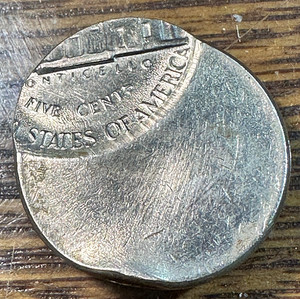
2019 nickel off-center strike error showing coin design shifted from center with blank planchet crescent visible

Off-Center Strike

RAREST
$50 – $600+

An off-center strike results when a planchet is not properly centered beneath the dies at the moment of striking. Instead of the full design being impressed onto the center of the planchet, the dies contact only a portion of the blank, leaving a crescent-shaped area of plain, unstruck metal on one side. The most dramatic examples show 20% to 50% of the design missing — still readable enough to identify the coin, but visibly abnormal.

For 2019 nickels, off-center errors are genuine mint escapes that passed quality control before leaving the production facility. The degree of misalignment is the primary value driver: a 5% off-center coin carries only a modest premium, while a 30%–50% off-center example with the date still visible is a prized error coin. Values escalate sharply with higher percentage misalignment and better grade.

Collectors insist the date remains readable as a key authentication and attribution requirement. An off-center 2019 nickel with 30%–50% misalignment and a visible date in uncirculated condition falls in the $200–$600 range based on documented sales. Dramatic examples certified by PCGS or NGC as "MS" grades with a clear off-center description can exceed $600 at major error coin specialist auctions.
How to spot it

Hold the coin and look for a blank, unstruck crescent of plain metal along one side of the planchet. The design should be visibly shifted toward the opposite edge. A genuine off-center strike has a full planchet diameter — it is not clipped or damaged post-mint.

Mint mark

Can occur at P (Philadelphia) or D (Denver). Proofs from San Francisco are not associated with off-center strikes due to their controlled production process.

Notable

CoinValueChecker.com documents that dramatic off-center 2019 nickels in uncirculated condition can reach $400–$600. The percentage of misalignment must typically exceed 10% to generate significant collector interest. Coins should be certified by PCGS or NGC for maximum market acceptance and to authenticate the error as a genuine mint production escape.

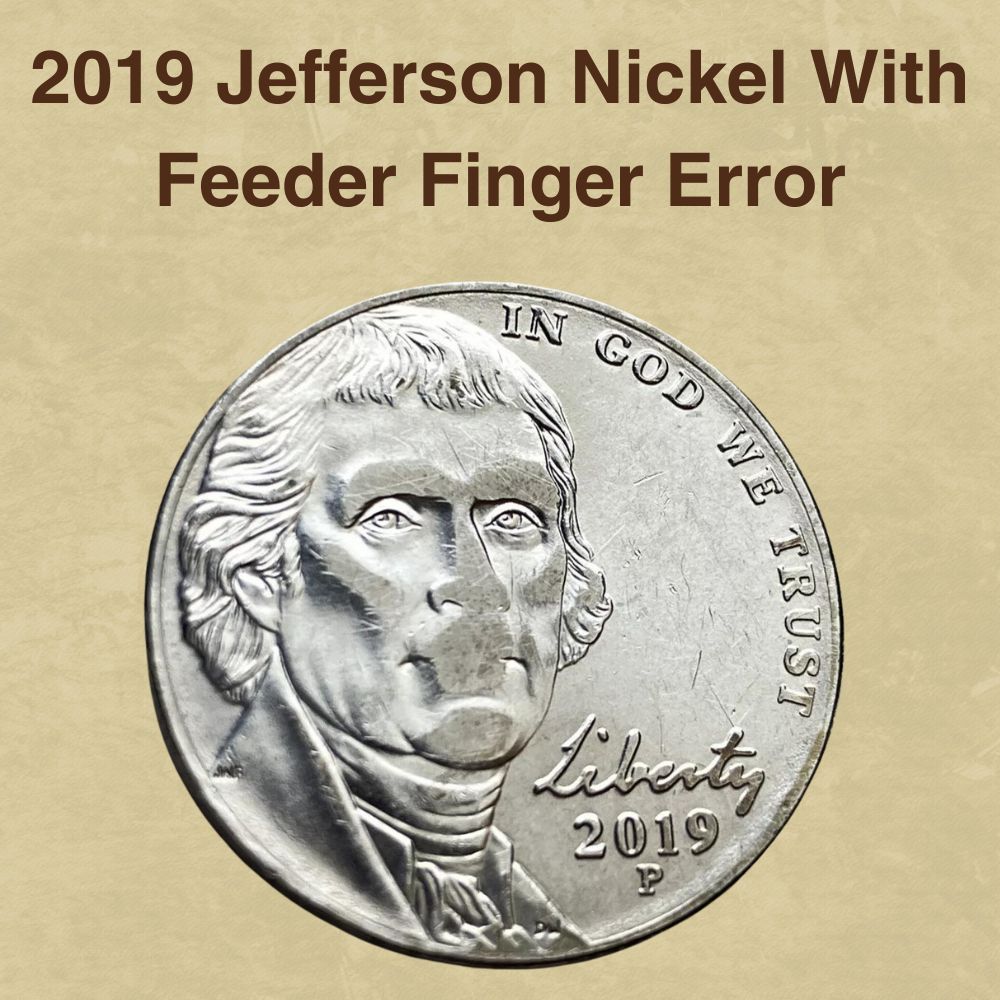
Close-up of 2019 nickel feeder finger error showing distinctive parallel raised lines across Thomas Jefferson portrait

Feeder Finger Error

BEST KEPT SECRET
$30 – $150+

The feeder finger is the mechanical arm inside the coining press that picks up blank planchets and positions each one between the dies just before the strike. If the feeder finger is worn, misaligned, or makes excessive contact with the planchet surface during placement, it can drag across the metal and leave distinctive parallel raised lines or grooves impressed into the planchet surface before the coin is struck.

The resulting coin shows these parallel horizontal lines as raised ridges running across Jefferson's portrait, particularly prominent across the cheekbone and hair detail. Unlike post-mint damage (which creates recessed scratches), feeder finger marks are raised above the coin's surface — a key diagnostic feature. This error is particularly associated with Philadelphia Mint 2019 production, where the mechanism's contact left identifiable patterns cataloged by error coin specialists.

Collectors prize feeder finger errors for their visual drama and their documentation of a specific mechanical failure at the mint. The raised lines create an unmistakable surface pattern that survives even moderate circulation. Uncirculated examples with clear, strong feeder finger impressions across the portrait field can sell for $30–$150 or more, with the strongest and most dramatic examples commanding the top end of that range from specialized error coin buyers.
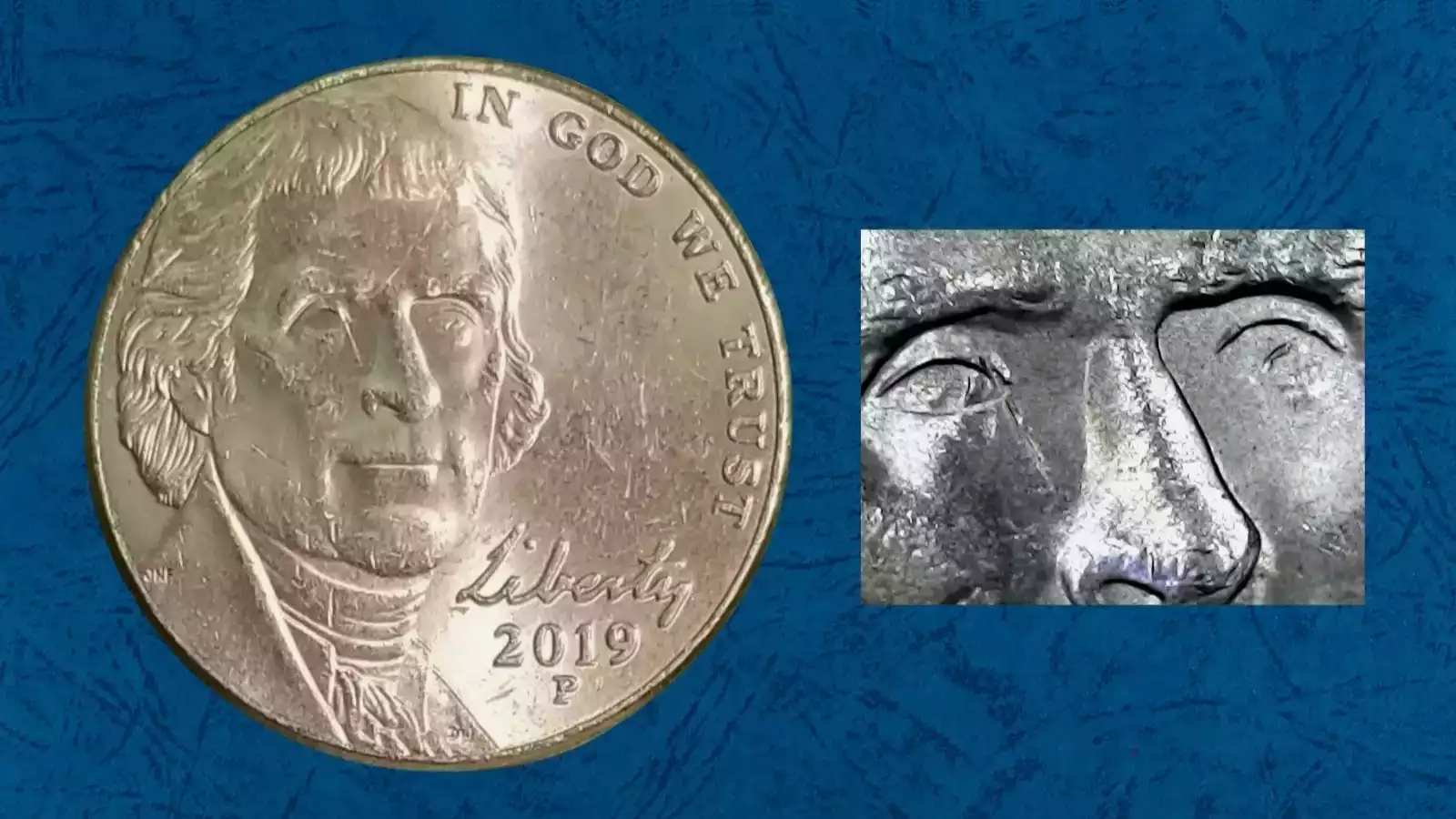
How to spot it

Examine Jefferson's portrait under a 10× loupe. Look for multiple parallel raised lines running horizontally across the face, cheekbone, or hair. Raised ridges (not recessed scratches) that appear to pre-date the coin's design elements confirm a mint-origin feeder finger error rather than post-mint damage.

Mint mark

Primarily P (Philadelphia) issues. The feeder finger error has been specifically associated with 2019-P production runs, though can theoretically occur at any facility.

Notable

CoinValueChecker.com and CoinValueApp.com (CoinKnow) both document the feeder finger as one of the most talked-about 2019 nickel errors. Because the lines are raised rather than recessed, grading services can typically distinguish genuine mint-origin feeder finger damage from post-mint scratches, making certification straightforward for strong examples.

Close-up of 2019 nickel lamination error showing metal surface peeling or cracking revealing subsurface planchet layer

Lamination Error

HIDDEN GEM
$15 – $100+

A lamination error occurs when impurities, gas pockets, or internal stresses in the metal alloy cause the planchet to crack, peel, or separate into layers either before, during, or after striking. For 2019 Jefferson Nickels, the cupro-nickel alloy (75% copper, 25% nickel) can develop these weaknesses when the incoming coin strip contains inclusions or when the rolling and annealing process introduces subsurface voids that are invisible at the time of striking.

The visible result on the finished coin is a flap, crack, or missing chunk of surface metal. Pre-strike laminations show as a flaw in the planchet before design details are pressed in; post-strike laminations develop after the coin was struck and may show a peeling layer that lifts away from the coin's face, partially obscuring portions of Jefferson's portrait or Monticello. The surface beneath the lamination typically has a different texture and color than the surrounding fields.

Lamination errors on 2019 nickels attract a steady collector base because each one is unique in size, location, and degree of metal separation. Large, dramatic laminations covering a significant portion of a major design element are the most desirable. Certified examples with the lamination clearly visible and the date confirmed sell reliably in the $15–$100 range, with exceptional pieces — particularly those showing a large peeled flap over the portrait — pushing higher with motivated bidders at specialized error coin auctions.
How to spot it

Look for a raised flap, crack, or peeled section of metal on either side of the coin. The affected area will have a different surface texture — often rougher or lighter — than the coin's normal field. Confirm it is not post-mint damage by checking that the edges of the affected zone show a natural, tapered metal separation rather than sharp impact marks.

Mint mark

Can occur at P (Philadelphia) or D (Denver) business strikes. Lamination errors are planchet-origin defects and are not specific to any single mint location.

Notable

Lamination errors are documented in the CoinValueChecker error list for 2019 nickels and on CoinValueApp.com (CoinKnow). Because the flaw originates in the metal strip before coining, each example is unique — a genuine pre-strike lamination confirmed by PCGS or NGC will carry a descriptive holder label noting the error type, location, and approximate size of the separation.

2019 Nickel Mintage & Survival Data

2019 Jefferson Nickel mint comparison showing P Philadelphia, D Denver, and S San Francisco examples side by side
Mint Mint Mark Type Mintage Notes
Philadelphia P Business Strike 567,854,400 Jamie Franki Signature FS variety available
Denver D Business Strike 527,040,000 Explore & Discover Set; First Day of Issue; FS PL designation
San Francisco S Proof Only 1,061,558 Deep Cameo (DCAM) proof; not released for circulation
Total (all mints) 1,095,957,062 Approx. 1.096 billion coins produced
Composition specs: 75% copper, 25% nickel — cupro-nickel clad. Diameter: 21.2 mm. Weight: 5.0 grams. Edge: Plain (smooth). Designers: Jamie Franki (obverse portrait), Felix Schlag (Monticello reverse, originally 1938). The melt value of a 2019 nickel is approximately $0.067 as of recent copper/nickel commodity pricing — slightly above face value.

Found one of these errors on your 2019 nickel? Calculate its estimated value now.

Use the Value Calculator →

Describe Your 2019 Nickel for a Detailed Assessment

Not sure what you have? Describe your coin in your own words and the tool below will match it to known varieties and give you a personalized assessment.

Mention these things if you can

  • Mint mark (P, D, or S)
  • Any wear visible on Jefferson's cheekbone
  • Step line count at Monticello base
  • Full mint luster present or absent
  • Any doubled outlines on the reverse
  • Unusual lines, marks, or missing metal

Also helpful

  • Color or toning (bright silver, dark, mottled)
  • Any off-center appearance
  • Raised ridges on Jefferson's face
  • Peeling or cracking on the surface
  • Any grading slab or label present
  • Where you found the coin

2019 Nickel Value Chart at a Glance

The table below covers all five major 2019 nickel types across four condition tiers. For a complete in-depth step-by-step 2019 nickel identification breakdown and reference, use the linked guide. Values are market-based ranges compiled from PCGS CoinFacts and documented auction results.

Type / Variety Worn / Circulated Uncirculated (MS60–66) Gem (MS67+) Proof (PR)
2019-P (no FS) $0.05 – $0.35 $1 – $4 $20 – $75
2019-P Full Steps FS ⭐ $0.15 – $0.40 $5 – $32 $40 – $195+
2019-D (no FS) $0.05 – $0.45 $1 – $7 $20 – $100
2019-D Full Steps FS 🔥 $0.15 – $0.35 $5 – $23 $50 – $350+
2019-S Proof DCAM $1 – $165

⭐ = Signature variety (most searched). 🔥 = Rarest/highest market premium. Values are ranges; individual coins vary. Based on PCGS CoinFacts auction data · 2026 edition.

🪙 CoinKnow lets you photograph your 2019 nickel's reverse and get an instant estimate of step completeness and grade range — a coin identifier and value app.

How to Grade Your 2019 Jefferson Nickel

2019 Jefferson Nickel grading strip showing four condition tiers from worn to gem uncirculated side by side

Worn / Good (G–F)

Jefferson's portrait is identifiable but cheekbone is flat and hair detail is lost. Monticello's columns are barely separated. Steps are completely merged. Value: face value only ($0.05). These are not worth submitting for grading.

About Uncirculated (AU50–58)

Light friction on Jefferson's highest cheekbone and the tops of Monticello's columns. Original mint luster visible in protected areas like the portrait's recesses. Still in the $0.30–$1 range. Steps typically show wear at the edges.

Uncirculated (MS60–66)

No circulation wear — full original luster throughout. May have bag marks or contact marks from production and handling. Jefferson's hair fully detailed. Steps visible but may be incomplete for FS designation. Value $1–$23 depending on mint and grade.

Gem (MS67+)

Outstanding surface preservation with minimal contact marks even under 5× magnification. Brilliant, unbroken luster. This is the grade tier where Full Steps designation creates dramatic value differences — $40 to $350+ depending on FS status and mint.

Pro tip for 2019 nickels: The Full Steps designation is evaluated separately from the numerical grade. A coin can be MS67 with no FS (worth ~$25) or MS67 with FS (worth $50–$75). Always examine the Monticello staircase before assigning value. For proof 2019-S coins, look for the Deep Cameo (DCAM) contrast between frosted devices and mirror fields — PR70DCAM is the top grade. Never attempt to clean the steps area; even a gentle wipe creates hairlines that disqualify FS under grader scrutiny.

📷 CoinKnow gives you a quick on-the-go grade estimate by comparing your coin photos to a reference database of certified examples — a coin identifier and value app.

Where to Sell Your Valuable 2019 Jefferson Nickel

Not all selling venues are equal for modern high-grade nickels. Match the venue to your coin's value tier for the best return.

🏆 Heritage Auctions

Best for PCGS or NGC certified 2019-D or 2019-P Full Steps examples graded MS67FS or higher, or dramatic error coins. Heritage reaches a global audience of advanced collectors willing to pay top dollar. Buyer's premiums are high, but competition drives strong final prices. Consignment minimums and timelines apply — plan 2–3 months ahead.

📦 eBay

The most active marketplace for certified and raw 2019 nickels across all grades. Check recently sold prices for 2019-P Jefferson Nickel FS listings on eBay using "sold listings" filters to see what comparable examples actually cleared. Raw (uncertified) coins sell best here in the $1–$30 range; slabbed examples attract more bidders and higher prices.

🏪 Local Coin Shop

Convenient and instant — you walk out with cash same-day. Dealers typically offer 50%–70% of retail for common uncirculated examples. For Full Steps coins or error coins they haven't seen before, they may not recognize the premium. Consider getting a PCGS or NGC opinion first. Better for selling rolls of common 2019 nickels than for selling a single gem specimen.

💬 Reddit r/Coins

A surprisingly active buying community. Post clear, well-lit photos of both sides plus a loupe shot of the steps area. Fellow collectors may recognize DDR varieties or Full Steps that a dealer missed. Prices trend closer to retail than a coin shop offers. Ideal for coins in the $5–$50 range where Heritage auction fees would eat most of the profit.

💡 Get It Graded First — It Pays Off for Full Steps Coins

A 2019-D MS67FS in a PCGS or NGC holder sells for $50–$75 on the open market. The same coin raw (ungraded) might bring $5–$15 from a cautious buyer. Grading fees run $20–$50 per coin, so the math works in your favor if you believe your coin qualifies for MS67FS or better. Only submit coins that appear Full Steps AND grade at least MS66 to ensure fees are covered by the value premium.

Frequently Asked Questions — 2019 Nickel Value

How much is a 2019 nickel worth?

Most 2019 nickels in circulated condition are worth exactly face value — five cents. Uncirculated examples without the Full Steps designation trade for $1 to $7 depending on grade and mint. The real value emerges with the Full Steps (FS) designation: MS67FS coins sell for $40–$75, and rare MS68FS examples have sold for $200–$350 or more at auction.

What is the Full Steps designation on a 2019 nickel?

Full Steps (FS) is a special designation awarded by PCGS and NGC to Jefferson Nickels that display five or six fully separated, uninterrupted steps at the base of Monticello on the reverse. The steps are the deepest cavity in the die, making them difficult to strike completely. A Full Steps coin proves the dies were fresh and the strike was full-pressure, which is rare in high-volume production years like 2019.

What is the auction record for a 2019 nickel?

The highest documented sale for a standard 2019 nickel variety is $250 for a 2019-D MS68, sold on eBay in July 2019 per PCGS CoinFacts. For the Philadelphia Mint, the record is $195 for a 2019-P MS68FS, sold March 30, 2022. Error coins can exceed these figures — a dramatic off-center strike in uncirculated condition can reach $400–$600 depending on the degree of misalignment.

How many 2019 nickels were made?

The Philadelphia Mint struck 567,854,400 business-strike 2019 nickels, and the Denver Mint produced 527,040,000. The San Francisco Mint struck approximately 1,061,558 proof-only nickels for collector sets. The total across all three mints was roughly 1.096 billion coins — making the 2019 nickel a high-mintage modern issue with value concentrated only in top-grade or Full Steps examples.

Which 2019 nickel mint mark is most valuable?

The 2019-D (Denver) is often most valuable in Full Steps grades because Denver's production showed exceptional step definition that year. The PCGS population for 2019-D MS68FS is only 3 coins, making it a top-population rarity. The 2019-D is also the only 2019 nickel offered in the exclusive Explore & Discover Set and First Day of Issue PCGS designations, which command further premiums.

What are the most valuable 2019 nickel errors?

The most valuable 2019 nickel errors include: off-center strikes (dramatic examples in uncirculated condition can reach $400–$600), feeder finger errors (distinctive parallel raised lines across Jefferson's portrait), lamination errors (planchet peeling), die chip or cud errors (raised lumps from broken die sections), and doubled die reverse (DDR) varieties with noticeable doubling on Monticello's architectural details.

How do I check for Full Steps on my 2019 nickel?

Flip the coin to the reverse and focus on the stairway at the base of Monticello's front entrance. Using a 10× loupe or magnifier, count the horizontal step lines. Five or six fully separated, uninterrupted lines running the complete width of the staircase earns Full Steps status. Any break, blending, or weakness caused by a weak strike, die wear, or contact mark disqualifies the coin.

Is a 2019-S nickel worth more than a regular nickel?

Yes. The 2019-S was struck only as a proof at the San Francisco Mint, with a mintage of about 1,061,558 coins. In PR69DCAM (Deep Cameo) condition these sell for roughly $10–$20, and PR70DCAM examples have sold for around $165. They are not intended for circulation and will always carry a premium over the common Philadelphia and Denver business strikes, though they are not rare in absolute terms.

Should I clean my 2019 nickel before selling it?

Never clean a collectible coin. Cleaning — even with gentle soap — permanently damages the microscopic flow lines in the mint luster and creates hairlines visible under magnification. A cleaned coin receives a 'details' grade from PCGS or NGC rather than a numerical grade, which dramatically reduces its value. Leave your 2019 nickel exactly as-is and let a grader assess its natural surface.

What does a 2019 nickel look like — what is on it?

The 2019 Jefferson Nickel features a forward-facing portrait of Thomas Jefferson on the obverse designed by Jamie Franki, with the inscriptions IN GOD WE TRUST, LIBERTY, and the date 2019. The reverse shows Monticello, Jefferson's Virginia estate, designed by Felix Schlag — the same reverse used since 1938 with updates. The coin is 21.2mm in diameter, weighs 5.0 grams, and is composed of 75% copper and 25% nickel with a plain edge.

Ready to Find Out What Your 2019 Nickel Is Worth?

Use our free calculator — select your mint mark, condition, and any errors in under 60 seconds.

Calculate My Coin's Value →